


Hotel Owner vs Hotel Manager: Common Conflicts & Solutions | Hotel Management Guide

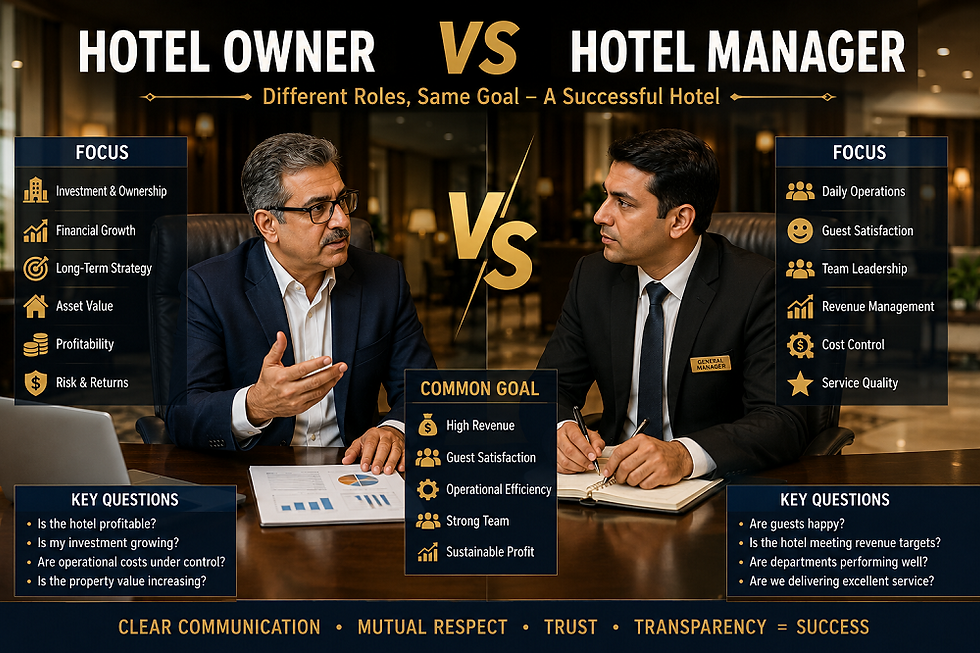
Running a hotel successfully requires a strong partnership between the hotel owner and the hotel manager. The owner invests capital and carries the business risk, while the hotel manager is responsible for converting that investment into efficient day-to-day operations, guest satisfaction and sustainable profitability.
However, conflicts between owners and hotel managers are common.
Typical disagreements include:
Revenue targets
Hotel expenses
Staff recruitment
Salaries
Purchasing
Discounts
Marketing expenditure
Maintenance
Guest complaints
SOP implementation
Vendor selection
Owner interference
Manager accountability
Profit expectations
The good news is that most of these conflicts can be reduced through clear authority, measurable KPIs, transparent reporting and a well-written management agreement.
What Is the Difference Between a Hotel Owner and Hotel Manager?
Hotel Owner
The hotel owner generally provides or controls:
Property investment
Building and land
Capital expenditure
Major financial decisions
Long-term business strategy
Brand/investment direction
Major renovation decisions
The owner is primarily concerned with:
Return on Investment + Asset Value + Long-Term Profitability
Hotel Manager
The Hotel Manager or General Manager is responsible for:
Daily hotel operations
Guest service
Staff management
Department performance
Revenue execution
Cost control
SOP implementation
Sales coordination
Maintenance
Quality standards
Management reporting
The manager is primarily concerned with:
Operations + Guest Satisfaction + Revenue + Profitability + Team Performance
Why Do Hotel Owner vs Manager Conflicts Happen?
Most conflicts occur because of one fundamental problem:
Unclear expectations and unclear authority.
An owner may believe:
"I own the hotel, so I should control everything."
A manager may believe:
"I am responsible for the hotel's performance, so I need operational authority."
Both perspectives can be understandable.
The solution is to clearly define who decides what.
1. Conflict Over Revenue Targets
One of the most common conflicts is unrealistic revenue expectations.
Owner Says:
"Last month revenue was ₹50 lakh. This month I want ₹60 lakh."
Manager Says:
"Occupancy is low and the market is weak."
The problem is not necessarily the target. The problem is whether the target is supported by:
Market demand
Occupancy forecast
ADR
Competitor pricing
Seasonality
Sales pipeline
Events
Distribution channels
Solution
Prepare a monthly Revenue Budget and Forecast.
Track:
Occupancy
ADR
RevPAR
Room revenue
F&B revenue
Banquet revenue
Total revenue
The owner should evaluate the manager against an approved business plan, not arbitrary daily expectations.
2. Conflict Over Hotel Expenses
Owners naturally want cost control.
Managers need to spend money to maintain operations.
For example:
Owner:"Why did you spend ₹2 lakh on maintenance?"
Manager:"The HVAC system required repair."
The correct question is not simply:
"Why did you spend the money?"
It should be:
"Was the expense necessary, approved and properly documented?"
Solution
Create an Expense Approval Matrix.
Example:
Expense | Approval |
Routine operating expense | Department/GM within budget |
Medium-value purchase | GM + Finance |
Large purchase | Owner/authorized management |
Emergency repair | GM, followed by reporting |
Major CAPEX | Owner/Board approval |
Exact approval limits should be defined in the management agreement.
3. Owner Interference in Daily Operations
This is one of the most damaging owner-manager conflicts.
An owner may directly instruct:
Receptionists
Housekeeping staff
Chefs
Security
Sales employees
without informing the General Manager.
This can create:
Confusion
Conflicting instructions
Poor accountability
Employee politics
Delayed decisions
Solution
The owner should normally communicate operational instructions through the General Manager or designated management structure, except for urgent safety, compliance or business-critical matters.
4. Manager Hiding Problems From the Owner
The opposite problem is also common.
A manager may avoid reporting:
Revenue decline
Staff resignations
Guest complaints
Cash discrepancies
Maintenance issues
Vendor problems
because they fear criticism.
This eventually makes the problem worse.
Solution
Create a culture of:
"Report the problem early + provide a solution."
Management reports should clearly show:
Problem → Cause → Action Taken → Required Support → Expected Result
5. Conflict Over Staff Recruitment
The owner may want fewer employees to reduce payroll.
The manager may want additional staff to maintain service.
For example:
Owner:"Why do you need five more housekeeping employees?"
Manager:"Occupancy is increasing and room turnaround is becoming difficult."
Solution
Use Manpower Planning based on:
Number of rooms
Occupancy
Check-outs
Restaurant covers
Banquet events
Operating hours
Productivity standards
Hiring should be based on workload rather than personal preference.
6. Conflict Over Hotel Salaries
Owners may compare salaries with nearby hotels.
Managers may argue that experienced employees require competitive compensation.
Both sides should examine:
Market salary
Employee skill
Position
Experience
Productivity
Replacement cost
Staff turnover
Solution
Create an annual:
Manpower Budget + Salary Structure + Performance Review System
7. Conflict Over Hotel Purchasing
Purchasing can become a major source of disagreement.
Questions may include:
Which vendor should be selected?
Why is the price higher?
Why are three quotations not available?
Why was the purchase made urgently?
Does the manager have a relationship with the supplier?
Solution: Purchasing SOP
Implement:
Purchase Requisition
Vendor Comparison
Quotations where appropriate
Purchase Order
Goods Receiving
Quality Check
Invoice Verification
Payment Approval
For emergency purchases, establish a documented exception procedure.
8. Conflict Over Vendors
Owners sometimes have preferred vendors.
Managers may prefer vendors based on:
Quality
Price
Reliability
Credit terms
Delivery
Service
Solution
Use an approved vendor evaluation system.
Evaluate:
Price + Quality + Reliability + Credit + Service
The best vendor is not always the cheapest vendor.
9. Conflict Over Hotel Renovation
Owners may want to renovate rooms immediately.
Managers may prefer to wait because:
Occupancy is high
Cash flow is limited
Existing rooms are still operational
Revenue would be lost during closure
Solution
Prepare a CAPEX Plan with:
Problem
Estimated cost
Expected benefit
Guest impact
Revenue impact
Priority
Timeline
Then classify:
Urgent → Necessary → Revenue Generating → Enhancement
10. Conflict Over Marketing Budget
Owners may say:
"Why are we spending money on digital marketing?"
Managers may say:
"Without marketing, occupancy will fall."
Solution
Marketing should have measurable objectives.
Track:
Leads
Direct bookings
Corporate accounts
Wedding enquiries
Website traffic
Conversion
Cost per acquisition
Revenue generated
Marketing should be evaluated by business results, not simply expenditure.
11. Conflict Over Discounts
Managers may offer discounts to increase occupancy.
Owners may believe discounts are reducing profitability.
Solution
Create a Rate & Discount Authority Matrix.
For example:
Normal rate
Corporate rate
Group rate
Long-stay rate
Promotional rate
Last-minute rate
Every discount should have:
Reason + Authorization + Revenue Objective
12. Conflict Over OTA Strategy
OTAs can increase bookings but also involve commissions and distribution costs.
The owner may say:
"OTA commission is too high."
The manager may say:
"We need OTAs to maintain occupancy."
Solution
Track:
OTA revenue
Commission
Net ADR
Occupancy contribution
Cancellation
Guest acquisition
Repeat/direct booking potential
The objective should be profitable distribution, not maximum OTA bookings.
13. Conflict Over Guest Complaints
Owners may become upset after seeing negative reviews.
Managers may blame guests or staff.
The correct approach is to identify the root cause.
Review:
Complaint type
Department
Response time
Resolution
Recurrence
Compensation
Training requirement
Solution
Use a Guest Complaint Register and monthly complaint analysis.
14. Conflict Over Hotel SOPs
Sometimes managers create SOPs but employees don't follow them.
Owners may blame the manager.
Managers may blame the employees.
Solution
SOP implementation should include:
SOP → Training → Demonstration → Checklist → Audit → Corrective Action
An SOP sitting in a file is not an operational system.
15. Conflict Over Hotel Accounts
Owners want accurate financial information.
Managers need timely operational reports.
Common issues include:
Revenue mismatch
Cash shortage
Pending receivables
Incorrect expense posting
Inventory discrepancy
Unapproved purchases
Solution
Create daily, weekly and monthly financial reporting.
Hotel Daily Owner Report
A concise owner report can include:
Revenue
Room revenue
F&B revenue
Banquet revenue
Other revenue
Rooms
Occupancy
ADR
RevPAR
Arrivals
Departures
Finance
Cash
Bank collection
Outstanding
Expenses
Operations
Guest complaints
Maintenance
Staff issues
VIP guests
16. Conflict Over Cash Flow
A hotel may be profitable on paper but still face cash-flow pressure.
Why?
Because:
Corporate payments are delayed
Vendor payments are due
Payroll is due
Taxes are due
CAPEX is required
Loan obligations exist
Solution
Prepare a 13-Week Cash Flow Forecast.
Track:
Opening Cash + Expected Collections – Expected Payments = Closing Cash
This helps owners and managers make decisions before a cash shortage becomes critical.
17. Owner Wants Immediate Profit
Some owners expect the hotel to generate strong profit immediately.
But hotels often require:
Staff recruitment
Training
Marketing
Repairs
Renovation
Working capital
Technology
Sales development
Solution
Agree on realistic phases:
Phase 1 – Stabilization
Operations and service standards.
Phase 2 – Revenue Growth
Sales and occupancy.
Phase 3 – Cost Optimization
Productivity and procurement.
Phase 4 – Profit Improvement
GOP and cash generation.
18. Manager Focuses Only on Revenue
High revenue does not necessarily mean high profit.
Example:
Revenue increases because the hotel heavily discounts rooms.
But:
OTA commissions increase
Payroll increases
F&B costs increase
Utilities increase
Profit may remain unchanged.
Solution
The GM should be measured on:
Revenue + GOP + Guest Satisfaction + Cost Control
not revenue alone.
19. Owner Focuses Only on Cost
The opposite problem is also dangerous.
Excessive cost cutting may lead to:
Poor housekeeping
Low-quality food
Staff shortages
Maintenance delays
Negative reviews
Employee turnover
Solution
Use:
Cost Optimization—not Cost Cutting
The objective is to remove waste while protecting service quality.
20. Conflict Over Staff Benefits
Staff meals, accommodation, uniforms, incentives and training can become areas of disagreement.
Solution
Create a written HR policy covering:
Salary
Attendance
Weekly off
Leave
Staff meals
Accommodation
Uniform
Incentives
Training
Performance appraisal
Employees should understand the policy before joining.
Owner vs Manager: Who Should Decide?
A practical authority matrix can help.
Decision | Owner | Hotel Manager |
Property investment | Final authority | Recommendation |
Major CAPEX | Approval | Proposal |
Daily operations | Oversight | Primary responsibility |
Staff scheduling | Oversight | Primary responsibility |
Guest service | Review | Primary responsibility |
Routine purchasing | Policy/limits | Execution |
Marketing plan | Approval/budget | Execution |
Revenue strategy | Strategic oversight | Execution |
Major recruitment | Approval as agreed | Recommendation/execution |
Emergency operations | Support | Immediate action |
Annual budget | Approval | Preparation |
Monthly reporting | Review | Preparation |
The exact division should be documented in the hotel's management agreement.
Hotel Owner and GM Weekly Meeting
A weekly owner-manager meeting can be extremely effective.
Agenda
Occupancy
ADR
Revenue
GOP
Sales pipeline
Guest complaints
Staffing
Cash flow
Maintenance
Purchasing
Marketing
Upcoming events
Key problems
Decisions required
Keep the meeting focused on facts, decisions and action items.
Hotel Owner Monthly Performance Review
Every month review:
Revenue
Actual vs Budget
Occupancy
ADR
RevPAR
F&B revenue
Cost
Payroll
Food cost
Utilities
Maintenance
Marketing
Profit
Departmental profit
GOP
GOP margin
Cash flow
Guest
Reviews
Complaints
Satisfaction
HR
Headcount
Turnover
Absenteeism
Vacancies
Hotel Owner vs Hotel Manager KPI System
A good KPI system prevents personal arguments.
Financial KPIs
Revenue
GOP
GOP Margin
ADR
RevPAR
Labour Cost %
Food Cost %
Operational KPIs
Guest satisfaction
Room cleanliness
Complaint resolution
Maintenance response
Audit compliance
Sales KPIs
Occupancy
Corporate accounts
Direct bookings
Banquet leads
Conversion
HR KPIs
Staff turnover
Absenteeism
Training
Productivity
The Importance of a Hotel Management Agreement
If the hotel is professionally managed, the management agreement should clearly define:
Management term
Scope of services
Management fee
Incentive fee
Budget approval
Bank account authority
Hiring authority
Purchasing authority
CAPEX approval
Marketing budget
Reporting
Audit rights
Performance standards
Termination conditions
Owner responsibilities
Manager responsibilities
This reduces ambiguity.
Hotel Owner vs Manager: The Golden Rule
The owner should generally focus on:
Investment + Strategy + Asset Value + Financial Oversight
The hotel manager should generally focus on:
People + Operations + Revenue Execution + Guest Experience + Profitability
Both should work toward the same objective:
A profitable hotel with satisfied guests and a strong long-term asset value.
How to Resolve an Existing Owner-Manager Conflict
If the relationship has already become difficult, use a structured process.
Step 1: Stop Personal Arguments
Move the discussion from:
"You are doing wrong."
to:
"What does the data show?"
Step 2: Identify the Issue
Is it:
Revenue?
Cost?
Staff?
Purchasing?
Authority?
Communication?
Performance?
Step 3: Review Evidence
Use:
Budget
P&L
Reports
SOPs
Contracts
KPIs
Step 4: Agree on Corrective Action
Write:
Action
Responsible person
Deadline
Expected result
Step 5: Review After 30 Days
Measure whether the solution worked.
30-Day Owner-Manager Relationship Improvement Plan
Week 1
Review:
Roles
Responsibilities
Authority
Existing conflicts
Week 2
Finalize:
KPIs
Budget
Reporting format
Approval matrix
Week 3
Implement:
Daily report
Weekly meeting
Monthly P&L review
Department KPI dashboard
Week 4
Evaluate:
Revenue
Costs
Guest satisfaction
Staff performance
Outstanding conflicts
Common Mistakes Hotel Owners Should Avoid
❌ Giving direct instructions to every employee
❌ Changing policies without informing the GM
❌ Setting unrealistic revenue targets
❌ Cutting essential maintenance
❌ Hiring based only on personal relationships
❌ Ignoring staff training
❌ Comparing every hotel with another property
❌ Making decisions without reviewing data
Common Mistakes Hotel Managers Should Avoid
❌ Hiding bad news
❌ Spending without authorization
❌ Ignoring owner concerns
❌ Overstaffing
❌ Poor financial reporting
❌ Allowing uncontrolled discounts
❌ Ignoring guest complaints
❌ Failing to implement SOPs
❌ Blaming employees for management problems
Best Solution: One Hotel, One Team
The most successful hotels operate on one principle:
Owner and Manager are not competitors—they are business partners with different responsibilities.
The owner brings:
Capital + Vision + Investment
The manager brings:
Experience + People + Operations + Execution
Together they create:
Revenue + Guest Satisfaction + Profit + Asset Growth
County Park & Suites – Hotel Management Solutions
County Park & Suites provides hotel management and hospitality consulting solutions designed to help owners improve operations, revenue and profitability.
Services can include:
Hotel Management
Hotel Operations Management
Hotel GM Support
Hotel SOP Development
Hotel Manpower Planning
Hotel Staff Recruitment
Hotel Staff Training
Hotel Revenue Management
Hotel Budget Preparation
Hotel P&L Management
Hotel Cost Control
Hotel Sales & Marketing
Hotel Pre-Opening
Hotel Reopening
Hotel Turnaround Management
Hotel Operational Audit
Owner Reporting Systems
The objective is to establish a professional operating structure where:
Owner = Strategic Control
Management = Operational Execution
Finance = Transparency
SOP = Consistency
KPI = Accountability
Hotel Owner vs Hotel Manager conflicts are usually not caused by one person—they are often caused by unclear roles, unclear authority, poor communication and unrealistic expectations.
A successful hotel requires a professional relationship based on:
1. Clear Responsibilities
Everyone should know who is responsible for what.
2. Clear Authority
Employees should not receive conflicting instructions.
3. Transparent Financial Reporting
Owners should have accurate information.
4. Measurable KPIs
Performance should be based on data.
5. Approved Budgets
Managers need an agreed operating framework.
6. Regular Meetings
Problems should be discussed before they become crises.
7. Professional SOPs
Operations should not depend on individual personalities.
8. Mutual Respect
Owners and managers bring different expertise to the business.
The ultimate goal is not for the owner to win or the manager to win.
The goal is:
The Hotel Wins.
When the owner provides strategic direction and resources, while the hotel manager is empowered to execute professionally, the property has a much stronger opportunity to achieve higher revenue, controlled costs, better guest satisfaction, motivated employees and sustainable profitability.


