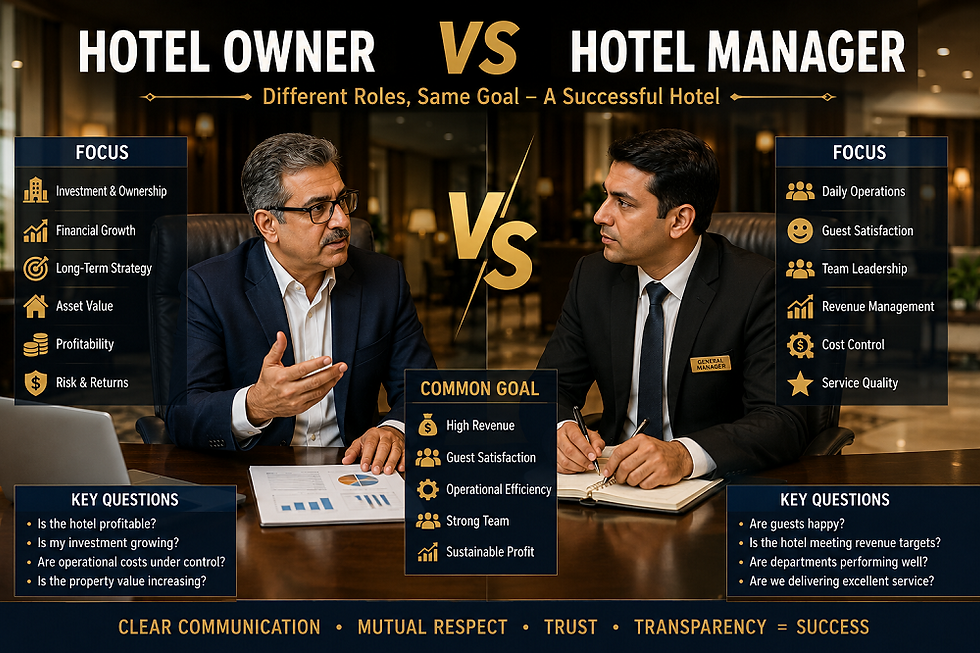
Owner vs Management Responsibility in Hotels


One of the most common reasons for operational failure and financial loss in hotels is unclear separation between owner responsibilities and hotel management responsibilities. Successful hotels operate on a clear governance model where owners focus on strategy and investment, while professional management handles daily operations.
This post explains the difference between owner and management responsibilities, why clarity is critical, and how proper role division improves hotel performance.
Understanding the Two Roles
Hotel Owner
The hotel owner is the asset holder and investor, responsible for long-term value creation, capital decisions, and governance.
Hotel Management
Hotel management (CEO, COO, Operations Director, GM) is responsible for day-to-day operations, service delivery, and profitability through SOP-driven execution.
Owner vs Management – Responsibility Comparison Chart
Area | Owner Responsibility | Management Responsibility |
Vision & Direction | Define vision and business goals | Translate vision into operational plans |
Capital Investment | Approve CAPEX and funding | Execute projects within approved budgets |
Budget Approval | Final approval of budgets | Prepare and manage budgets |
Daily Operations | Not involved | Full responsibility |
Pricing & Rates | Approve strategy | Implement revenue management |
Vendor Selection | Approve policy | Select and manage vendors |
Staffing | Approve structure | Recruit, train, manage staff |
Guest Handling | Rare & escalated only | Daily guest experience |
SOPs | Approve framework | Implement and monitor |
Compliance | Oversight | Execution and audits |
What Owners Should Do (Value-Adding Role)
Strategic Oversight
Define long-term business goals
Approve expansion and brand strategy
Review performance at board level
Financial Governance
Approve annual budgets
Monitor ROI and asset value
Sanction major expenditures
Leadership & Culture
Appoint qualified management
Support leadership stability
Promote ethical governance
What Owners Should NOT Do
Interfere in daily hotel operations
Override management decisions at ground level
Direct junior staff or vendors
Offer unauthorized discounts
Bypass SOPs and controls
What Hotel Management Is Responsible For
Operational Execution
Room operations, F&B, engineering, security
SOP implementation and audits
Guest satisfaction and service recovery
Financial Performance
P&L management
Cost control and profitability
Revenue optimization
People Management
Recruitment and training
Staff discipline and motivation
Performance evaluation
Impact of Blurred Responsibilities
Issue | Result |
Owner micromanagement | Staff demotivation |
No authority clarity | Slow decisions |
SOP bypassing | Service inconsistency |
Rate interference | Revenue loss |
Vendor favoritism | Quality issues |
Best Practices to Define Owner vs Management Roles
1. Authority Matrix
Define financial and operational limits
Document approval levels
2. Structured Reporting
Daily flash reports
Monthly P&L reviews
Quarterly performance meetings
3. Professional Management Structure
Owner → CEO → COO → Operations Director → GM
4. Clear Communication Channels
One point of contact
No direct instructions to frontline staff
Benefits of Clear Role Separation
Higher profitability
Stronger management accountability
Improved guest experience
Lower staff attrition
Better asset valuation
Owner vs Management – Simple Rule
Owners govern the business.Management runs the business.
Hotels that follow this principle consistently outperform those with blurred roles.
Clear separation between Owner and Management responsibilities is not about reducing control—it is about creating structured control through systems and leadership. Hotels that respect this boundary build stronger teams, deliver consistent guest experiences, and achieve sustainable profitability.